
Article
The circular economy: ADEME's 7 pillars, explained simply
Definitions, concepts and concrete examples: ADEME's 7 pillars of the circular economy, explained by Circul'R.
What exactly is the circular economy? And what does it mean in practice for a company or a region?
ADEME answers with a framework of 7 pillars, organised around 3 broad areas: what economic players offer, consumer demand and behaviour, and waste management. At the centre: prevention and efficient resource management. The shorter the loop, the smaller the impact.
Why a framework of 7 pillars?
Since the industrial revolution, our economy has followed a linear model: extract → process → consume → discard. Since 1970, raw material extraction has increased 3.5-fold, exceeding 100 billion tonnes a year (UNEP, 2024). The circular economy offers a structured alternative model.
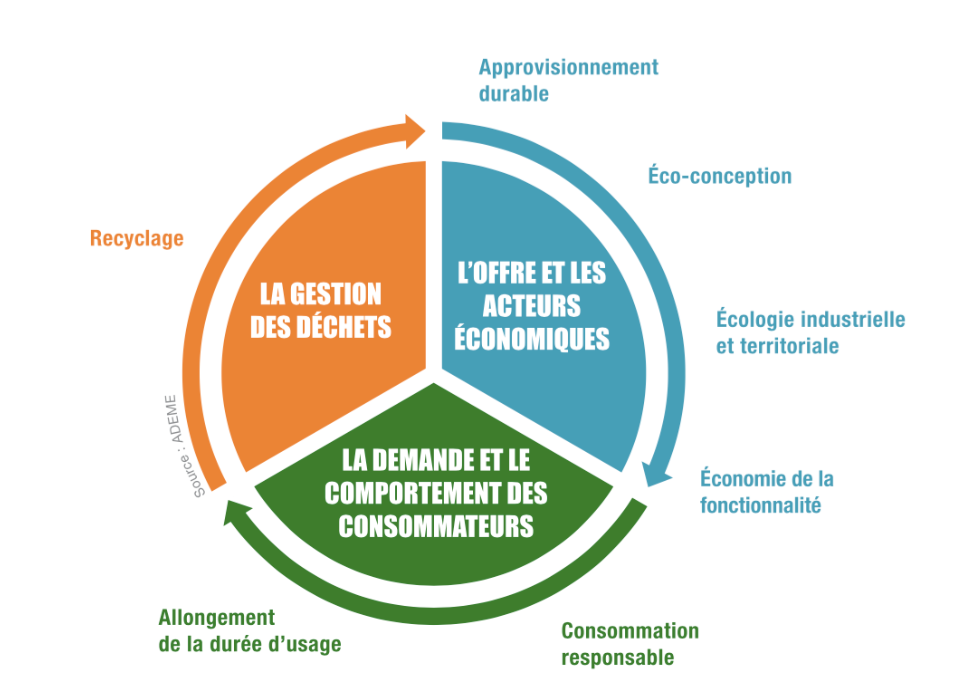
Area 1 — What economic players offer
Pillar 1: Sustainable sourcing
Building environmental and social criteria into procurement, favouring secondary (recycled) and renewable materials. Example: the Fairphone 5 uses 100% recycled rare earths and 90% recycled plastic.
Pillar 2: Eco-design
Building environmental criteria in from the design stage: "waste is a design error". Life Cycle Assessment (LCA) is the central tool. Example: Lesieur removed the cardboard sleeve from its mayonnaise tubes (−259 t of cardboard, −22% CO₂ emissions from the tube).
Pillar 3: Industrial and territorial ecology
Optimising material and energy flows between players in the same area: one company's waste becomes another's resources. The benchmark: the industrial symbiosis at Kalundborg (Denmark).
Area 2 — Consumption and demand
Pillar 4: Responsible consumption
Steering choices towards more durable products, for individuals (buying less and better) and professionals alike (sustainable public procurement, ESG criteria). Public procurement accounts for around 10% of GDP.
Pillar 5: Extending useful life
Extending the life of products: reuse, repair, refurbishment, remanufacturing, repurposing, second-hand. The golden rule: the shorter the loop, the better the impact.
Pillar 6: Product-service systems
Selling use rather than ownership. Examples: Signify (light as a service), Michelin (tyres by the kilometre).
Area 3 — Waste management
Pillar 7: Recycling
Reprocessing end-of-life materials so they can be fed back into a production cycle. This is a long loop, essential but not an ambition in itself. EPR schemes fund recycling in France.
The rule of loops: why the order matters
From the most to the least virtuous: Refuse → Reduce → Reuse → Repair → Refurbish → Recycle → Energy recovery. Communicating only about your recycling rate risks telling an incomplete story, or even amounting to greenwashing.
What this changes for your business
A circular economy strategy is a matter of economic resilience: pressure on raw materials, CSRD obligations, client requirements. At Circul'R, we support more than 120 organisations across all of these pillars.
FAQ
What you need to know about us.
Qu'est-ce que Circul'R ?
Circul'R est un cabinet de conseil spécialisé en économie circulaire. Depuis 2016, il accompagne plus de 150 grandes entreprises et acteurs publics à travers des missions de conseil, des coalitions sectorielles, des programmes de formation et le Club Circul'R.
What types of organizations do you work with?
Contrairement à un cabinet RSE généraliste, Circul'R est spécialisé exclusivement en économie circulaire depuis 2016. Cette expertise transverse - filières, réglementations (AGEC, REP, ESPR), business models - lui permet de transformer la circularité en avantage compétitif mesurable : réduction d'impact, sécurisation des ressources, conformité et nouveaux relais de croissance.
What is the process for a consulting project with Circul'R?
Circul'R conseille les grandes entreprises privées - dont de nombreux groupes du CAC 40 et du SBF 120 - sur leurs décisions stratégiques, tous secteurs confondus. Le cabinet accompagne également les acteurs qui déploient les politiques publiques d'économie circulaire : éco-organismes, agences, bailleurs de fonds et collectivités.
Do you operate only in France or internationally as well?
Circul'R propose quatre offres complémentaires : des missions de conseil sur mesure pour structurer votre stratégie circulaire, des coalitions sectorielles pour résoudre des problématiques communes entre entreprises, des formations pour monter en compétence sur l'économie circulaire, et le Club Circul'R, le réseau des entreprises engagées dans la transition circulaire.
How can the circular economy be practically integrated into an existing business strategy?
Circul'R accompagne ses clients sur l'ensemble du cadre réglementaire français et européen de l'économie circulaire : loi AGEC, filières REP, CSRD, ainsi que les textes européens récents (PPWR, ESPR, CRMA). Le cabinet traduit ces obligations en feuilles de route opérationnelles, pour transformer une contrainte de conformité en avantage stratégique.
What is a sector-based coalition and how can I participate?
Une mission démarre par un diagnostic de vos enjeux circulaires (approvisionnement, éco-conception, business model, réglementation, etc.). Circul'R construit ensuite une feuille de route chiffrée et priorisée, avant d'accompagner le déploiement opérationnel des actions retenues jusqu'à la mesure d'impact et l'ajustement continu de la trajectoire.
How do you measure the results of your projects?
Basé à Paris, Circul'R intervient principalement en France et en Europe. À l'international, il accompagne des projets de coopération : partage de l'expertise française sur la REP, appui aux bailleurs de fonds sur leurs programmes de transition circulaire dans les pays émergents, via un réseau de partenaires opérationnels et d'experts sectoriels.
What is the average duration of a project?
Contactez l'équipe via le site : Circul'R analyse vos enjeux puis propose le dispositif adapté (mission de conseil, rejoindre une coalition, suivre une formation ou adhérer au Club) pour accélérer votre transition vers l'économie circulaire.